Choosing a learning management system is an important decision for any construction business. The right platform can make training easier to manage, improve visibility across the workforce and give employees and contractors a simpler way to access learning.
However, not every LMS will be suited to the way construction businesses operate. Construction teams can be spread across multiple sites with different roles, working patterns and training requirements. Contractors may need access to specific learning while permanent employees follow their own training pathways. Managers also need a clear view of what has been completed and where attention is needed.
This means choosing a Construction Learning Management System is about more than finding somewhere to host online courses. It is about finding a platform that fits the way your business and your people work.
What Should You Look for in a Construction Learning Management System?
There are plenty of LMS platforms available but the most suitable option will depend on your workforce, your training requirements and how you currently manage learning.
Before choosing a platform, consider the following areas:
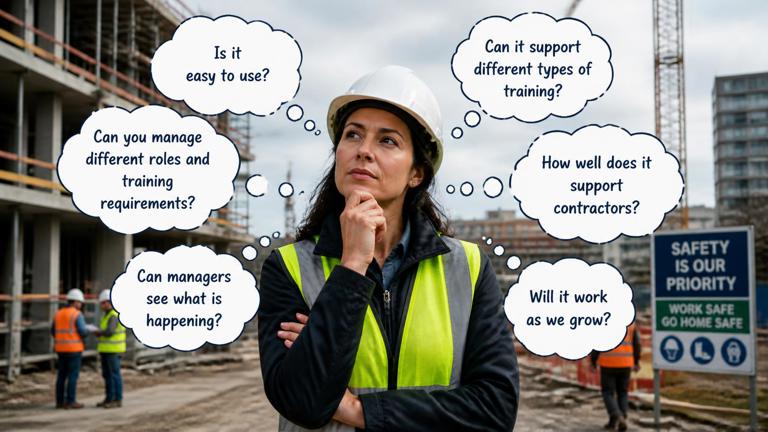
1. Is it easy for your workforce to use?
An LMS might have an impressive list of features but if employees struggle to use it then it is unlikely to deliver the results you need.
Construction workers may have very different levels of experience with digital systems. Some will use technology every day while others may primarily work on site and have limited access to a computer.
A good Construction LMS should be straightforward to navigate. Employees should be able to find their training, complete it and check their progress without needing extensive guidance.
It is also worth considering how the platform works on mobile devices. For frontline teams, being able to access learning from a phone or tablet can make a significant difference.
2. Can it support different types of training?
Construction workforce training is rarely limited to online courses.
Your LMS may need to support a combination of:
- Online courses
- Inductions
- Policies and procedures
- Documents
- Assessments
- Competency development
- Practical training records
- Ongoing professional development
Look for a platform that allows different types of learning to work together rather than forcing everything into a single format.
This gives you greater flexibility as your training requirements change.
3. Can you manage different roles and training requirements?
Not everyone in a construction business needs to complete the same training.
A site operative may have different requirements from a project manager. A new starter may need a structured induction while an experienced employee needs ongoing development. Contractors may only require access to specific information for the project they are working on.
Your Construction Learning Management System should make it possible to assign relevant training based on factors such as role, department, location or responsibilities.
This can save time for managers while helping employees focus on learning that is relevant to them.
4. How well does it support contractors?
Contractors and subcontractors are an important part of the construction workforce. Managing their training can be challenging when they move between projects or work with different teams.
A contractor learning platform should make it easier to provide the right information and training without creating unnecessary administration.
Consider whether the system allows you to:
- Give contractors appropriate access
- Assign project or role specific training
- Track completion
- Manage different groups of workers
- Remove or change access when circumstances change
The aim is to make contractor training part of the same organised process as employee learning.
5. Can managers see what is happening?
Once training is being delivered through an LMS, managers need more than a list of courses.
Good reporting should make it easy to understand the current position across your workforce.
For example:
Who has completed their training?
Who has outstanding learning?
Which training is coming up for renewal?
Are there gaps within a particular team or location?
Can completion records and certificates be accessed when required?
Clear reporting can remove a lot of the manual work involved in managing training and give managers greater confidence in their records.
6. Will it work as your business grows?
The LMS that works for you today should not become a problem as your workforce expands. Think about where your business could be in the next few years. You may add new sites, employ more people, take on additional contractors or introduce new training programmes.
A scalable Construction LMS should be able to grow with you without requiring you to completely change the way training is managed.
It is worth asking whether the platform can support multiple sites, departments, user groups and training pathways as your requirements develop.
Construction Training Software Should Reduce Administration
One of the main reasons businesses invest in construction training software is to make training easier to manage. If your current process involves spreadsheets, email reminders, paper certificates and manually checking completion, it is worth considering how much time your team spends keeping everything up to date.
A good LMS can bring these processes together. Automated training assignments and reminders can reduce the need for managers to chase individuals. Digital records make it easier to find information when it is needed. Reporting gives a clearer picture of training across the business without having to pull information together manually.
The goal should not simply be to move an existing paper based process online. The right platform should make the process itself more efficient.
Consider the Experience for Frontline Teams
It is easy to choose an LMS based on what works well for administrators. However, the people using the system every day are just as important.
Consider what training looks like from an employee's perspective. Can they access it easily? Is it clear what they need to complete? Can they use it on a mobile device? Will they receive reminders when something is due?
These details can have a significant impact on engagement. Employee training software for construction should make learning feel accessible rather than creating another complicated system for employees to navigate.
The best platform for your business is one that works for both the people managing training and the people completing it.
What About Practical Training?
An LMS should complement practical learning rather than attempt to replace it. Construction is a hands on industry. Employees need experience, supervision and opportunities to apply what they have learned in real working environments.
Your LMS can support this by providing the knowledge and information that sits alongside practical training.
For example, an employee might complete an online course before attending a practical session. Their competency could then be assessed in the workplace with the result recorded within the same system.
This creates a more complete training journey while keeping the administration in one place.
Questions to Ask Before Choosing an LMS
Before committing to a platform, it is worth taking the time to understand how it will work in your organisation.
Ask potential providers:
Can employees access the platform from mobile devices?
Can training be assigned automatically?
Can different roles and sites have different training requirements?
How are contractors managed?
What reporting is available?
Can documents and policies be included alongside courses?
Can the system support practical training and competency records?
How easy is it for administrators to manage?
What support is available when we need help?
Can the platform grow with our organisation?
It can also be useful to arrange a demonstration rather than relying solely on a feature list. Seeing how the system works in practice can give you a much better idea of whether it will suit your workforce.
Choosing a Construction LMS That Fits Your Business
There is no single LMS that will be right for every construction business.
The best choice will depend on the size of your workforce, the number of sites you operate, how you work with contractors and the type of training you need to manage.
The important thing is to look beyond the number of features a platform offers. Consider how easy it will be for your team to use, how much administration it could save and whether it gives managers the visibility they need.
A Construction Learning Management System should ultimately make training simpler, more accessible and easier to manage.
Summary
Choosing the right LMS is an investment in how your business manages learning. The right platform can bring training, records and communication together while giving employees and contractors easier access to the information they need.
If you are considering a Construction LMS and want to see what a platform could look like in practice, Expert LMS can help.
You can speak to our friendly team, book a free demo or start your free trial to explore the platform for yourself and see how it could support your construction workforce.