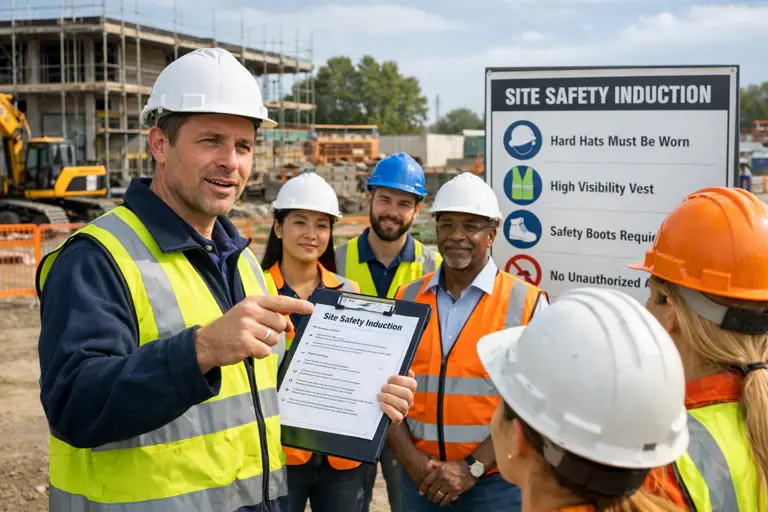
Growing UK contractors often operate across several live projects at once, each with different risks, client expectations and workforce needs. Without a structured approach, training standards can drift, one site may deliver detailed guidance, another might rely on quick verbal run throughs and a third could be using materials that no longer reflect current practice. The result is uneven competence, increased risk and workers who feel unsure rather than supported.
This guide explains how multi‑site contractors can build a consistent, compliant and scalable construction employee training programme; one that strengthens safety, improves retention and keeps teams productive across every project.
Why Construction Employee Training Matters for Multi‑Site Contractors
1. Safety and Legal Compliance
Construction remains one of the highest risk industries in the UK. Under the Health and Safety at Work etc. Act 1974 and CDM 2015, contractors must ensure workers are trained, competent and aware of the hazards they face. Consistent training is essential for meeting these duties across multiple sites.
2. Workforce Competence and Confidence
Clear, structured construction workforce training helps operatives feel prepared, capable and confident. CIPD research shows that strong early training improves engagement and reduces turnover - a major advantage in a sector facing ongoing skills shortages.
3. Client and Principal Contractor Requirements
Large clients increasingly expect contractors to demonstrate robust training standards, verified competence cards and up to date records. A unified approach to construction staff training makes this easier to evidence during audits or pre‑qualification checks.
4. Operational Efficiency Across Sites
When every site follows the same training structure, workers can move between projects without repeating unnecessary courses or missing essential ones. Managers spend less time chasing paperwork and training gaps become easier to identify and resolve.
Common Challenges in Multi‑Site Construction Training
Multi‑site contractors often face:
These pressures highlight why a clear, standardised training framework is so important for multi‑site contractors.
Best Practices for Construction Employee Training
1. Build a Company Wide Training Framework
Start with a core training programme that applies to every worker, regardless of site. This should include:
This becomes the core of your company wide training programme.
2. Add Site Specific Training Modules
Each project will have unique hazards, layouts and client rules. Add short modules covering:
This keeps construction staff training meaningful to each project while still following a consistent company standard.
3. Standardise Training Materials Across All Sites
Provide every site with the same:
This helps every site deliver training to the same standard, wherever the project is based.
4. Use Accredited Construction Training Courses Where Appropriate
For specialist roles or high risk activities, accredited courses help ensure competence and compliance. Examples include:
Integrating accredited courses into your programme strengthens your overall construction learning strategy.
5. Digitise Training Records for Accuracy and Visibility
Digital systems make multi‑site training significantly easier to manage. A focused LMS can:
This reduces administrative errors and ensures training data is stored securely and consistently.
6. Train Supervisors to Deliver Consistent On Site Instruction
Even the best training materials fall short if delivered inconsistently. Provide short sessions for supervisors covering:
This helps supervisors deliver construction employee training in a clear, consistent way across every site.
A reliable, standardised process is the strongest safeguard against these pitfalls.
Where a Learning Management System Helps
Digital tools make multi‑site training smoother, more reliable and easier to evidence. An LMS can centralise training content, track qualifications, flag renewals and give managers real time visibility of workforce competence across every project.
It acts as the central system that keeps training organised, compliant and easy to manage across multiple sites.
A well designed training programme is one of the most effective ways multi‑site contractors can raise safety standards, meet compliance obligations and build a capable workforce. With digital tracking and the ability to create site specific modules, competence becomes easier to maintain and documentation remains clear and accessible.
As contractors grow, digitising training becomes the simplest way to stay consistent across every project. Expert LMS can support you with construction training delivery, certification tracking and multi‑site workforce oversight whenever you’re ready.