Choosing a learning management system for your hospitality business is one decision. Finding the time and resources to create all the training your employees need is another.
From restaurants and bars to hotels and multi-location hospitality groups, we understand how quickly training requirements can grow. Food hygiene, beverage knowledge, customer service and management development all need attention, alongside the procedures and standards that are unique to your business.
That's why we believe a hospitality LMS should offer more than a place to upload courses. A built-in course library gives your team access to ready-made learning, while the ability to create your own content means you can build training around how your business actually operates.
But having hundreds of courses available is not enough on its own. What matters is whether that content is relevant to your employees, how easily you can deliver it and whether your learning platform gives you the visibility to manage training effectively.
Why a Built-In Course Library Matters for Hospitality
Hospitality teams need to learn a wide range of skills, but not every subject requires a course to be developed from scratch.
Food hygiene, workplace safety, customer service and management skills are relevant across much of the industry. Creating learning materials for each of these areas can take considerable time, especially when your team is already managing recruitment, onboarding and day to day operations.
Having ready-made courses available means you can introduce structured learning without first building an entire training library yourself.
This is particularly useful for growing hospitality businesses, where new employees need access to relevant knowledge across different departments and locations.
Of course, the courses still need to be suitable for your workforce. Content quality, relevance and any applicable training requirements should always take priority over the number of courses a provider advertises.
What Courses Should a Hospitality LMS Include?
The right course selection depends on your business, your employees and the knowledge they need to do their jobs.
A restaurant might prioritize food hygiene, allergen awareness, beverage knowledge and customer service. A hotel may also require supervisory training and broader management development. Across multiple locations, shared learning can help establish a consistent foundation for employees joining different teams.
Our course library includes over 100 courses as standard, covering hospitality-related subjects alongside leadership, management and wider workplace learning.
Some examples include:
Coffee Academy: Develops knowledge of coffee and its preparation.
Learn Wine: Introduces wine knowledge and relevant serving considerations.
Guinness, The Perfect Pour: Covers product-specific beverage knowledge and preparation.
Food Hygiene Level 2: Introduces fundamental food hygiene and safety principles.
These courses provide a useful starting point for different roles, but we would always recommend reviewing the content against your own training requirements.
For example, a wine course might help a server understand different varieties and serving techniques, while your own training would explain which wines appear on the menu and how they complement the dishes you serve.
The aim is to give employees knowledge they can use, rather than simply asking them to complete courses.
Combining Ready-Made Courses With Your Own Training
Every hospitality business has its own way of working.
Your restaurant might have particular standards for presenting dishes, handling customer requests or recommending products. A hotel may have established procedures for guest arrivals, housekeeping inspections and service recovery.
Those details cannot be fully covered by a general industry course because they depend on how your business operates.
Our AI-assisted Course Builder helps you create learning around those requirements. You can use existing documents as a starting point for course content, then review and develop the material with videos, quizzes and interactive elements.
For example, when introducing a new menu, you could build a course covering the dishes, ingredients, allergens and presentation standards employees need to understand before launch.
This gives you control over the information being taught while allowing your team to benefit from existing courses where they are appropriate.
How Much Time Can a Built-In Course Library Save?
The amount of time saved will depend on your business and how much relevant training content you already have.
Consider a restaurant group preparing to open three new locations. Each venue will need employees trained in areas such as food hygiene, workplace safety and customer service, alongside its own operational procedures.
Without existing learning content, the central team may need to develop or source courses for each subject before employees can begin their training.
A built-in library can reduce that initial workload, allowing more attention to be given to venue-specific material and practical preparation.
There is no meaningful universal figure for the hours saved. The benefit depends on how well the available courses match your requirements and how much content would otherwise need to be created.
It's also worth distinguishing between developing courses and administering training. Ready-made content can reduce course preparation, while the wider LMS functionality determines how efficiently learning is assigned, delivered and tracked.
Getting the Right Training to Every Hospitality Team
A kitchen employee, front desk receptionist and restaurant manager have different responsibilities, so their training should reflect that.
Assigning the same courses to everyone can create unnecessary learning and make it harder for employees to identify what is relevant to their roles.
With our Automations feature, you can automatically enroll employees into courses based on their branch, job role or department.
For example, a new restaurant employee could receive relevant introductory learning, while a newly appointed manager could be assigned additional development courses.
This helps you organize training across different teams without manually managing every individual course assignment.
For hospitality groups operating several venues, it also provides a practical way to maintain shared learning requirements while accounting for differences between locations.
Making Hospitality Training Accessible Around Shifts
Hospitality employees often work outside conventional office hours, and many spend very little time at a desk.
A restaurant team might work split shifts, while hotel employees could be covering early mornings, evenings or overnight operations. Finding a shared computer and arranging a suitable training session is not always straightforward.
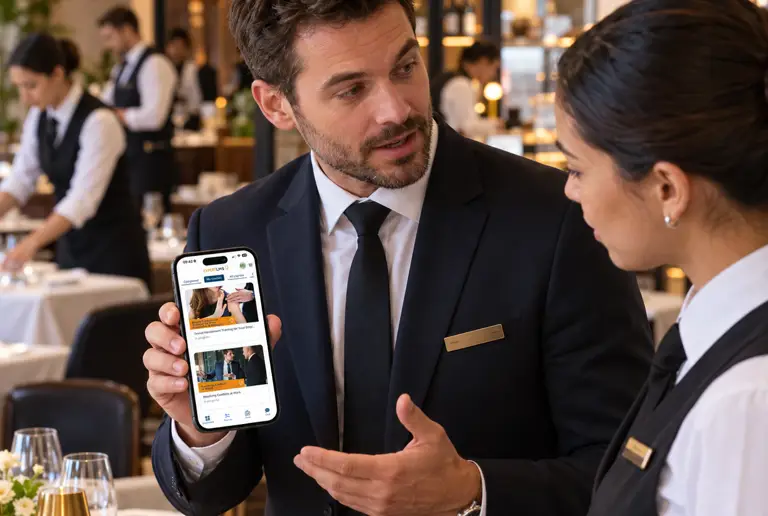
Our iOS and Android app allows employees to view and complete assigned courses from their mobile devices, giving them another way to access learning.
This can make it easier to organize training across different working patterns without depending entirely on a fixed training room or desktop computer.
Mobile access should still be supported by appropriate training time and guidance. Giving employees access to learning is important, but they also need the opportunity to complete it properly and ask questions if something is unclear.
Tracking Training Across Multiple Hospitality Locations
When you are responsible for training across several restaurants or hotels, understanding what has been completed can become increasingly difficult.
Individual managers may know how their own teams are progressing, but a central learning team also needs visibility across the wider business.
Our Reporting tools allow you to create custom real-time reports covering learner activity, course completions and engagement. Matrix reporting can also provide a view across branches, departments and job roles.
This helps you identify outstanding learning, compare activity between locations and determine where additional support may be needed.
However, completing a course does not automatically demonstrate that an employee can apply what they have learned.
A bartender might understand the principles covered in a product knowledge course but still need practice and feedback before confidently preparing drinks or making recommendations during service.
We believe online training works best when learning records are supported by practical observation, coaching and opportunities to apply new knowledge.
Using a Course Library for New Employee Onboarding
Hospitality businesses regularly welcome new employees, often into roles with similar initial learning requirements.
A structured onboarding program can give new starters a clearer introduction to the business, rather than leaving each manager to decide independently what training should be delivered.
You might begin with relevant courses from the library before introducing employees to your own service standards, products and workplace procedures.
From there, practical experience and feedback can help employees develop the confidence needed to carry out their responsibilities.
Our Career Paths feature can also support structured learning journeys that bring together courses, reviews, checklists and other development activities.
This allows you to think beyond an employee's first few shifts and consider how their learning should progress as they gain experience.
Keeping Hospitality Training Relevant as Your Business Changes
Menus change, new products are introduced and operational procedures develop over time.
When that happens, employees need access to accurate information that reflects how the business currently operates.
For your own training content, it is worth establishing who is responsible for reviewing courses, approving updates and ensuring changes are communicated to the relevant teams.
Our Course Builder allows you to create and edit internal learning, while our Document Library provides a central place for policies, guides and other workplace resources.
You can also use mandatory viewing and document sign-offs when employees need to acknowledge particular information.
These tools make it easier to manage learning materials within one platform, although your business remains responsible for checking that its own content is correct and up to date.
Hospitality Training With Expert LMS
Keeping hospitality training relevant means having the right courses available, the flexibility to create your own and a clear way to manage employee learning as your business grows.
At Expert LMS, we bring all of this together in one platform, combining a library of over 100 ready-made courses with the tools to develop, deliver and track training across your workforce.
Start your free trial or book a personalised demo to see how Expert LMS can support your hospitality training requirements this week.