Starting an online training business no longer means building an entire learning platform from the ground up. A white label learning management system lets you use an established technology platform under your own brand. Depending on the provider, you can apply your own name, colours, domain, content and mobile application, then sell the service directly to your customers. White label LMS opportunities aren't all designed for the same purpose, and selling courses online doesn't always mean the same thing. Some platforms are built primarily for selling individual courses to consumers, such as someone who makes content teaching people to use cameras and lenses. Others are designed to manage training for a single employer. A smaller number allow a company to operate a genuine business to business software service, supporting multiple corporate clients under its own brand. Before comparing systems, you need to decide what sort of business you actually intend to build.
I started as a course creator selling the Personal Alcohol Licence course in the UK. It used to be delivered face to face, and I was the first person in the UK to put it online. For several years it was hugely successful. You're welcome to get in touch on LinkedIn if you'd like to know more about that.
Deciding Which Business Model You Want
There are two fundamentally different online training business models, and the right white label LMS depends entirely on which one you're building.
Selling Individual Courses Online
This model is centred on selling courses, coaching, memberships or digital learning products directly to individuals. A customer visits your website, purchases a course, and completes it online. Commercial success depends heavily on the viability of your subject, the quality of your course, your ability to attract traffic, generate leads and convert
visitors into paying customers. The technology normally focuses on ecommerce and online payments, course landing pages, marketing funnels, email campaigns, promotional codes, memberships and communities, affiliate programmes, learner reviews, mobile
course access and individual course purchases. This model can work particularly well for coaches, consultants, subject experts and training organisations with an established audience. However, revenue can be transactional. You have to keep finding new customers unless you
build a strong membership or subscription model, or unless your course covers something mandatory, as was the case with the UK Personal Licence Course, something people had to complete before they could legally sell alcohol.
Operating a Recurring Revenue B2B SaaS LMS
A business to business SaaS LMS model works very differently. Rather than selling one course to one person, you
provide an ongoing learning and workforce platform to employers. Each client pays a monthly or annual subscription
based on its number of users, locations or required services.
Clients typically use the platform for employee onboarding, mandatory training, compliance management, career
development, company communications, document distribution, digital signatures, reviews and objectives,
competency management, operational checks, reporting and HR system integrations.
The LMS becomes part of the client's operational infrastructure. That creates more predictable recurring revenue
and longer commercial relationships. A serious B2B SaaS LMS business normally requires separate environments for
multiple clients, central management of every client account, recurring subscription charging, corporate reporting,
organisational structures, user permissions, branded web portals, a branded mobile application, API access, HR and
workforce integrations, secure hosting, technical maintenance and continuing product development.
The commercial focus is on winning and retaining contracted business clients rather than continually selling
individual courses.
Why the Distinction Matters
Both models involve online learning, but they create entirely different businesses. A course selling platform may be
excellent at marketing and ecommerce, yet unsuitable for managing 20 corporate clients with thousands of
employees. A sophisticated corporate LMS may be ideal for business clients, but unnecessarily complex for someone
who simply wants to sell a £99 online course.
For example, a course seller might need to sell 1,000 courses at £100 to generate £100,000. A B2B LMS company
could generate the same annual revenue from 20 corporate clients paying £5,000 each.
Neither model is automatically better. The right choice depends on your market, experience, sales capability and
long term ambition. Selling individual courses is largely a content and marketing business. Operating a recurring
revenue B2B LMS is closer to running a software company.
How Expert LMS Came About
I originally worked as a course creator, developing and selling training directly to individuals. One of my first major
successes was the UK Personal Alcohol Licence course, which people are required to complete if they want to apply
for a personal licence to sell or authorise the sale of alcohol.
At the time, the course was traditionally delivered through face to face classroom training. I became the first person
in the UK to offer it fully online. It was enormously successful for several years because it solved a clear problem.
People needed the qualification, they were actively searching for it, and they were prepared to pay to complete the
training.
Following that success, I created a wider range of hospitality courses, including food safety, health and safety,
manual handling and other essential workplace training. I quickly discovered an important difference between a
compulsory Personal Alcohol Licence course and these additional courses. Although businesses needed the training,
much of it wasn't compulsory for every individual employee in the same way. Fewer people actively searched for the
courses, and the cost of Google Ads often exceeded the revenue generated from individual course sales.
That forced me to rethink the business model. Rather than selling each course separately, I grouped the courses
together and offered hospitality businesses access to the entire training library for a fixed monthly fee. Businesses
paid according to the number of employees using the system. A pub with 30 employees, for example, might pay
£2.50 per person each month through a rolling annual contract. When an employee left the business, the employer
could simply reassign that space to a new employee without paying an additional fee.
That changed the model from relying on individual course sales to building predictable, recurring revenue from
multiple businesses.
The next stage was driven by customer demand. As we began working with more businesses, including larger
organisations, they needed more than access to a library of courses. They needed better reporting, improved
administration, greater control over employee training and the ability to create and manage their own learning
content. To meet those requirements, we kept developing the technology behind the courses. What began as a
simple system for delivering my own training gradually evolved into a comprehensive learning management
platform.
Expert LMS was created through that evolution. I moved from selling one successful online course, to providing a
subscription based training library, and then to building a complete software platform that enables organisations to
create, deliver, manage and report on their own training.
Today, Expert LMS isn't simply a place to access online courses. It's a scalable learning and workforce platform
designed to help businesses manage training, compliance, communication, documentation, employee development
and operational processes. The journey wasn't based on one grand plan from the beginning. It developed by
listening to customers, responding to commercial challenges and continually improving the solution. What started
with one online Personal Alcohol Licence course ultimately became Expert LMS.
White Label LMS Comparison
Insert Optimised PNG Grid From Document Here*
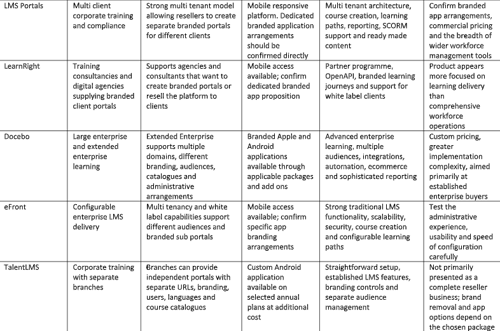
The platform information above is based on providers published product and partner information as available in July 2026. Features, packages and commercial rights should be confirmed directly before entering into any agreement.
Which Platform Is Right for You?
Choose Kajabi, Thinkific or LearnWorlds when your main objective is to sell courses, coaching, memberships or
digital products to individuals. Consider Docebo, eFront, TalentLMS, Moodle Workplace or Absorb LMS when you
need an enterprise learning system and have the resources to configure and manage it. Review LMS Portals and
LearnRight when you want a partner focused, multi client learning proposition. Consider Expert LMS when you want
to launch a fully branded B2B SaaS LMS business, secure recurring corporate contracts and provide a much broader
service than course delivery alone.
Branding an LMS Is Not the Same as Owning an LMS Business
Many platforms describe themselves as white label because they allow a customer to change the logo, colours or
domain. That doesn't necessarily mean they provide a complete white label business opportunity. A serious
prospective reseller should ask the provider some direct questions. Can I set my own prices? Can I contract directly
with my clients? Can I manage multiple corporate clients, each with its own users and locations? Can I have my own
branded mobile application? Can I connect the platform to client HR systems, and is there a complete API? Who
manages hosting and security, and who maintains the mobile applications? Who develops new features and
supports complex technical integrations? Does the pricing leave sufficient margin, and can the platform support my
growth over several years?
A branded course portal may allow you to sell training. A comprehensive multi client platform can allow you to build
a software company.
Why Expert LMS Is Different
Expert LMS was built as a working commercial SaaS platform serving real employers with demanding operational
requirements. It wasn't created only as a website for hosting courses. A white label partner can offer the same broad
platform capabilities available to Expert LMS clients, presented under the partner's own brand.
The partner doesn't need to recruit a complete development team, build mobile applications, establish hosting
infrastructure, maintain app store compliance, create its own reporting engine, develop every HR integration,
manage platform releases, or rebuild the product as technology changes. Expert LMS performs that work in the
background, so the partner can concentrate on its market, its clients and its recurring revenue.
We've examined the worldwide LMS market extensively. There are credible reseller platforms, powerful enterprise
systems and excellent course selling products. However, we haven't identified another opportunity that combines
the same breadth of corporate learning tools, wider workforce functionality, white label control, branded
applications, integration capability, ready made content and direct development support in precisely the same
proposition. That's the real opportunity. It isn't simply access to an LMS. It's access to the technology, infrastructure
and development capability required to operate a branded SaaS LMS company.
Build the Business Without Building the Technology
Creating an advanced LMS involves far more than building the initial software. It requires continuous investment in
software developers, mobile applications, hosting, cyber security, data protection, integrations, reporting, technical
support, testing, product development, compatibility updates and infrastructure management. A white label
partnership can remove much of that cost, delay and risk.
For the right business, Expert LMS provides an opportunity to enter the corporate learning technology market with
an established platform, branded applications, continuing development and a technical team already in place. You
build the customer relationships and recurring revenue. Expert LMS powers the technology behind your business.
Frequently Asked Questions
What is a white label LMS?
A white label LMS is a learning management system built by one company but rebranded and sold by another under
its own name, domain and identity. It allows a reseller to offer a fully featured platform without building the
underlying technology themselves.
What's the difference between selling courses online and running a B2B SaaS LMS?
Selling courses online is a content and marketing business built on individual transactions. Running a B2B SaaS LMS is
a recurring revenue software business built on multi year contracts with employers who use the platform for
onboarding, compliance, HR and workforce management.
Which white label LMS is best for corporate clients and HR integrations?
Platforms built specifically for multi tenant, recurring B2B revenue, such as Expert LMS, LMS Portals and Docebo, are
generally the strongest fit, since they include API access, HR integrations, branded mobile apps and separate client
environments as standard.
Do I need my own development team to run a white label LMS business?
No. The purpose of a genuine white label partnership is that the provider manages hosting, security, app store compliance, integrations and ongoing product development, so the partner can focus on sales, client relationships and recurring revenue.
Is Expert LMS suitable for selling individual courses to consumers?
Expert LMS is built primarily for recurring B2B SaaS contracts with employers rather than public course marketplaces or one off consumer sales. Platforms like Thinkific, LearnWorlds or Kajabi are better suited to that model.