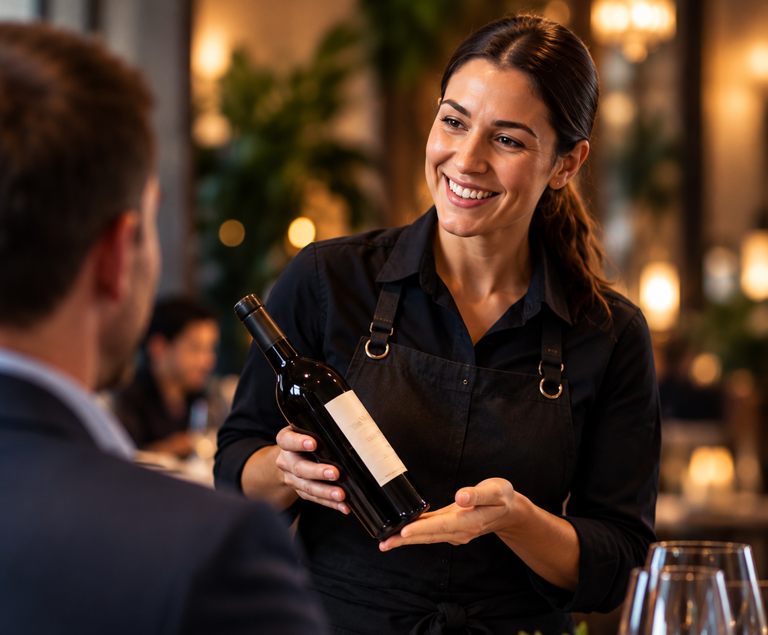
Ask for a wine recommendation in most bars, pubs and restaurants and watch what happens. Either you get a shrug and a pour of whatever's already open or you get someone who actually asks what you're eating, thinks for a second and tells you why a particular glass fits. The first response is service. Nothing went wrong, the order still arrived. The second is selling, and it's the version that turns one glass into two, or a glass into a bottle, without anyone feeling sold to.
Most hospitality training only ever produces the first kind of staff member. Not because anyone decided pleasant but passive service was good enough, but because being pleasant doesn't require knowing anything about what's actually being served, and most training stops exactly where product knowledge would need to start.
Service and selling are not the same skill
Service is executing a decision the guest has already made. Take the order accurately, bring it out promptly, be polite throughout and the job's done well. Selling is shaping the decision before it's finalised, which requires something service doesn't, a genuine opinion, backed by real knowledge, that the staff member is willing to put forward with enough confidence that the guest trusts it. A business can train service to a high standard without ever touching this. Plenty do.
Why most training only ever reaches “service”
The standard customer service curriculum, the kind covering clear communication, handling a difficult conversation, staying culturally aware, is genuinely useful and genuinely necessary. It's also, by design, about how someone interacts, not what they know. A course on de-escalating a complaint doesn't touch what's actually on the menu. A course on cultural sensitivity doesn't cover why a particular wine pairs with a particular dish. None of it was ever meant to. The gap isn't a flaw in customer service training, it's simply outside what that training is for, which is exactly why product knowledge has to be treated as its own category rather than assumed to be covered somewhere else.
The real blocker isn't attitude, it's confidence built on knowledge
It's tempting to read weak upselling as a motivation problem, staff who can't be bothered or don't care about the till total. In practice it's usually simpler and less fixable by a pep talk. Recommending something specific means staking a small amount of personal credibility on it. Someone who doesn't actually know the difference between two options has no confident recommendation to give, so they default to the safest possible move. Ask the guest to choose, or suggest nothing at all. That's not laziness. It's an entirely reasonable response to not knowing enough to do otherwise, and it's exactly what disappears once real product knowledge is in place.
Nobody confidently recommends something they don't understand. The confidence isn't the missing ingredient. The knowledge underneath it is.
What this looks like with wine specifically
Wine is the clearest version of this problem because it's the category most staff feel least qualified to talk about. A guest asking what pairs well with their meal, and getting back a specific, reasoned answer rather than a shrug, is rare enough outside a formal dining room that it genuinely stands out when it happens. Not because staff don't want to help. Because most have never been given enough of the underlying knowledge, grape varieties, food pairings, serving temperature, to make a recommendation they'd trust themselves. Once that knowledge exists, the same interaction that used to end in a shrug becomes a specific, confident suggestion, and that shift is exactly what the gap between service and selling looks like in practice.
Why this isn't just a wine problem
It's tempting to file this under fine dining and move on, but the same mechanism shows up anywhere a staff member has to represent a product they don't fully understand. A barista who genuinely knows the difference between origins and roast styles can guide someone toward a drink they'll actually enjoy more, not just the one they asked for by habit. Expert LMS even has a course dedicated to pouring the perfect pint of Guinness, because getting that pour right and being able to explain why the wait for it is worth it, is exactly the same confident recommendation skill applied to a completely different drink. A fine dining setting isn't a requirement for any of it. It requires the staff member knowing something specific enough to say with confidence, which is available to a casual pub exactly as much as it is to a tasting menu.
Product knowledge goes stale exactly when the menu changes
Compliance training expires on a fixed schedule. Product knowledge expires the moment a business does something it should actually be proud of, changing the wine list for the season, adding a new coffee origin, rotating in a new dish. The gap between what's actually being served and what staff can confidently talk about reopens immediately after every menu refresh, which quietly undoes months of earlier training unless the course behind it updates at the same pace. An AI course builder that can turn an updated wine list or a new menu document into a refreshed course in minutes, rather than a project someone has to schedule and remember, is what keeps product knowledge current without treating every seasonal change as a reason to fall behind again.
Building product knowledge without turning it into a chore
Getting there doesn't need a lengthy course writing project. Expert LMS includes Learn Wine, a shorter, venue-focused course on making practical recommendations, alongside Essential Wine Knowledge for Everyone for anyone who wants a deeper foundation, plus Coffee Academy covering origins, drink types and machine use, all included as standard rather than something to build from a blank page. Starting from ready made content means the barrier to actually running this training is low enough that it gets done, rather than staying a good idea nobody gets round to.
Proving it landed, not just that the video played
Completion isn't the same as capability. Someone can sit through a course on wine pairing and still freeze the first time a guest actually asks a question. Building a quiz into a course, rather than relying on completion alone, gives a genuine check on whether the knowledge is actually there, not just whether the content was technically viewed. (which matters far more for a skill that only shows itself in an unscripted moment with a real guest standing at the table)
Making product knowledge something worth having
Knowledge that never gets recognised tends to stay theoretical. Branch leader boards and visible progress give staff a reason to actually engage with product training beyond box ticking, turning “who knows the menu best” into something staff can see and take a bit of pride in, rather than a fact nobody outside the kitchen ever finds out. It doesn't need to be heavy handed to work. It just needs to make the effort of learning visible.
What to look for if you're building this properly
A few questions are worth asking before assuming current training already covers this:
Does any current training actually teach staff about the product, or does it stop at how to behave while serving it?
Could a new starter confidently answer a specific recommendation question today, or would they default to asking the guest to choose?
Is there a way to check the knowledge actually landed, beyond a course being marked complete?
Does the training assume a fine dining setting, or does it work for a casual venue too?
Is there any visible recognition for staff who genuinely know their menu well, or does it go unnoticed either way?
Common questions
Is training staff to upsell the same as training them to be pushy?
Not if it's done properly. A pushy sale comes from a script being followed regardless of the guest. A genuine recommendation comes from actual knowledge applied to what a specific guest is actually having. The first feels transactional because it is. The second usually feels like good service, because from the guest's side, that's exactly what it is.
Does this only make a difference in fine dining?
No and treating it as a fine dining problem is exactly how most venues miss the opportunity. A confident coffee recommendation or a well-poured pint creates the same kind of small, positive impression as a well chosen wine, and casual venues serve far more of those everyday moments than fine dining ever does.
How do you actually measure whether this training is working?
Completion data alone won't show it, since finishing a course and being able to use it under pressure aren't the same thing. Scored quizzes within the course give a more honest signal and beyond that, the real evidence tends to show up in ordinary measures a hospitality business already tracks, like average spend per table or per head, over time.
Should product knowledge training be mandatory or optional?
Compliance training earns its mandatory status because the downside of skipping it is serious. Product knowledge is different, it's a growth lever, not a risk to manage, so the better question is usually how to make it genuinely appealing to complete rather than whether to force it. Recognition and visible progress tend to do more here than a mandatory flag ever will.
What happens to product knowledge training when the menu changes?
It needs updating at the same speed the menu does, which is the part most businesses quietly skip. A wine list refreshed every season but a training course left untouched for two years means staff are being asked to sound confident about wines they've never actually been taught. Treating the course as something that gets revisited every time the offering changes, not as a one off project finished when it was first written, is what keeps the training matching what's actually on the table.
How Expert LMS supports this
This is exactly the gap between service and selling that Expert LMS's course library is built to close. Ready made wine training and food and drink courses give staff real product knowledge from day one, rather than leaving it to whoever happens to be confident enough to teach themselves.
Adding a quiz to a course checks whether that knowledge actually landed, not just whether the content was opened, and branch leader boards make genuine product expertise something visible and worth having, rather than a private skill nobody outside the till ever notices.
See how our platform fits your business. Book a demo or start a free trial with Expert LMS today!